
MODULE 5: Debt Elimination Strategies
Duration: 40 minutes
Learning Objectives:
•Compare proven debt payoff methods
•Choose the right strategy for your situation
•Create a personalized debt elimination plan
•Stay motivated through the debt payoff journey
Content Outline:
6.1 The Debt Snowball Method (10 min)
How It Works:
1.List debts smallest to largest (ignore interest rates)
2.Pay minimums on everything
3.Put all extra money toward smallest debt
4.When smallest is paid, roll that payment to next smallest
5.Repeat until debt-free
Example:
•Credit Card A: $500 balance, $25 minimum
•Credit Card B: $2,000 balance, $60 minimum
•Auto Loan: $8,000 balance, $300 minimum
•Student Loan: $15,000 balance, $150 minimum
With $200 extra per month:
•Month 1-3: Pay $225 to Card A, minimums on rest → Card A paid off
•Month 4-12: Pay $285 to Card B → Card B paid off
•Continue snowball…
Advantages:
•Quick wins build momentum and motivation
•Psychologically powerful
•Simplifies finances (fewer accounts)
•Recommended by Dave Ramsey (popular method)
Disadvantages:
•May pay more in interest overall
•Mathematically not optimal
•Requires emotional discipline
Best For:
•People who need motivation from quick wins
•Multiple small debts
•Those who’ve failed other methods
•When psychology matters more than math
6.2 The Debt Avalanche Method (10 min)
How It Works:
1.List debts highest to lowest interest rate
2.Pay minimums on everything
3.Put all extra money toward highest rate debt
4.When highest rate is paid, roll payment to next highest
5.Repeat until debt-free
Same Example, Avalanche Method:
If rates are: Card A (24%), Card B (19%), Auto (6%), Student (4.5%)
With $200 extra per month:
•Attack Card A first (highest rate 24%)
•Then Card B (19%)
•Then Auto (6%)
•Finally Student loan (4.5%)
Advantages:
•Saves most money in interest
•Mathematically optimal
•Fastest route to debt freedom (time-wise)
•Recommended by financial mathematicians
Disadvantages:
•First payoff may take longer
•Can be demotivating if highest balance has highest rate
•Requires more discipline
Best For:
•Disciplined, analytically-minded people
•Large gaps in interest rates
•When time matters (avalanche faster than snowball)
•Strong motivation regardless of quick wins
6.3 Hybrid and Alternative Methods (10 min)
The Debt Snowflake Method:
•Find tiny bits of extra money daily/weekly
•Immediately apply to debt (don’t wait)
•Examples: Sell unused items, skip one coffee, cash back rewards, found money
•Turn snowflakes into snowballs
The Debt Tsunami Method:
•Like avalanche but prioritizes emotionally draining debts
•Pay off debt causing most stress first
•Combines psychology and math
•Best for debts affecting mental health
Balanced Hybrid Approach:
•Start with one small debt for quick win (snowball)
•Then switch to avalanche for remaining debts
•Gets motivation boost then saves on interest
The “Stack” Method for Multiple High-Rate Debts:
•If several debts have similar high rates (within 2%)
•Pay smallest of the high-rate group first
•Gets quick win while still tackling high interest
Balance Transfer Strategy (Use with Caution):
•Transfer high-rate debt to 0% promotional card
•ONLY if you commit to paying off during promo period
•Requires discipline and stable income
•Can save thousands in interest
•Danger: Running up old cards again
6.4 Creating Your Personal Payoff Plan (10 min)
Step 1: Choose Your Method
•Based on your personality and situation
•Consider: What motivates you? Quick wins or maximum savings?
•Can always adjust if first choice isn’t working
Step 2: Find Extra Money
Income Side:
•Ask for raise (even 3% helps)
•Side hustle (deliver food, freelance, odd jobs)
•Sell unused items
•Temporary second job (intense but effective)
•Work overtime if available
•Tax refund straight to debt
•Bonuses to debt
Expense Side:
•Cut subscription services (average household: $273/month)
•Meal prep vs. eating out (save $200+/month)
•Downgrade phone plan
•Shop insurance rates (auto, home)
•Refinance high-rate loans if possible
•Eliminate or reduce expensive habits
•Free entertainment alternatives
•Negotiate bills (call providers)
Realistic Goal: Find $300-500/month extra for debt
Step 3: Automate the Process
•Set up automatic payments day after payday
•Make extra payments automatic
•Don’t rely on willpower – automate it
Step 4: Track Progress Visually
•Chart on wall
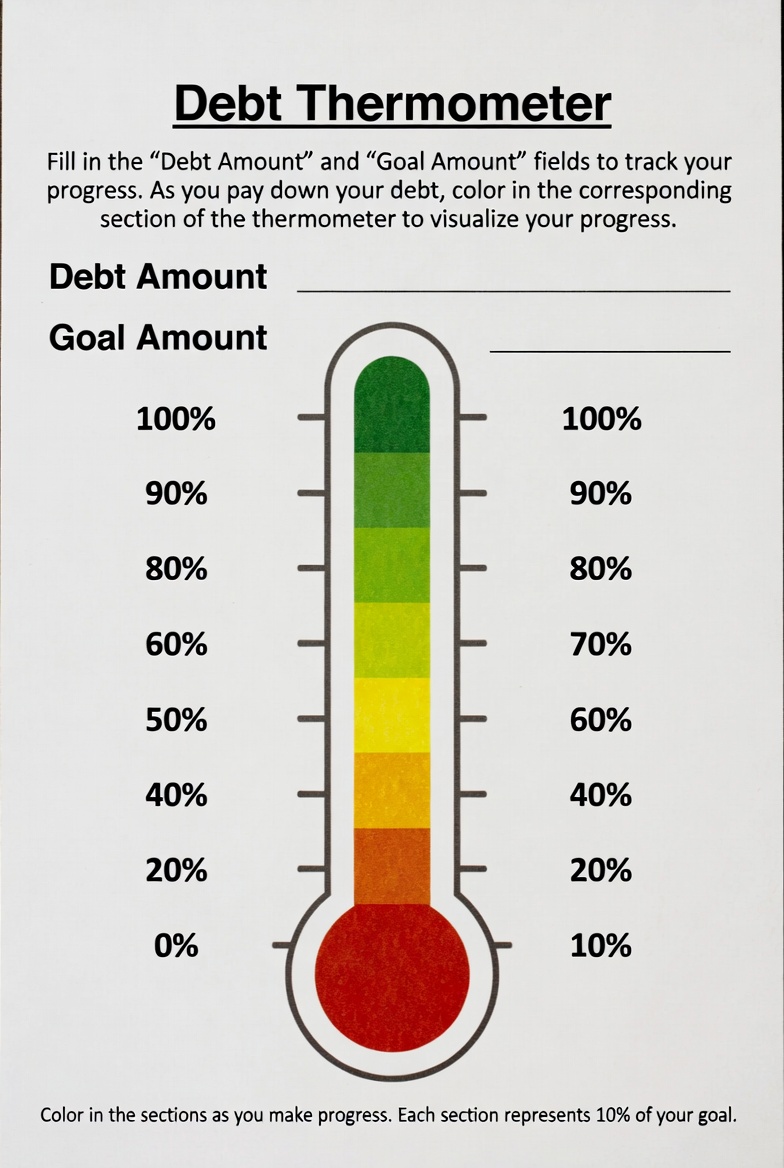
•Debt thermometer to color in
•Spreadsheet with graphs
•Apps that show progress
•Celebrate milestones (free/cheap ways)
Step 5: Plan for Obstacles
•What if income drops? (Minimum plan)
•What if emergency happens? (Mini emergency fund)
•What if you slip up? (Get back on track, don’t quit)
•What if it takes longer? (Adjust timeline, keep going)
Step 6: Stay Motivated
•Join online debt payoff community
•Find accountability partner
•Visualize debt-free life daily
•Track every victory
•Remember your “why”
•Reward milestones appropriately
Interactive Elements:
•Snowball vs. Avalanche Calculator: Compare both methods with your numbers
•Payoff Method Quiz: Which strategy fits your personality?
•Extra Money Finder: Interactive tool to identify $500/month
•Visual Progress Tracker: Printable debt thermometer
Downloadable Resources:
•Debt Snowball Worksheet (Excel)
•Debt Avalanche Worksheet (Excel)
•Extra Income Ideas List (PDF)
•Budget Cuts Checklist (PDF)
•52-Week Debt Payoff Challenge Tracker (PDF)
•Motivation & Milestone Celebration Guide (PDF